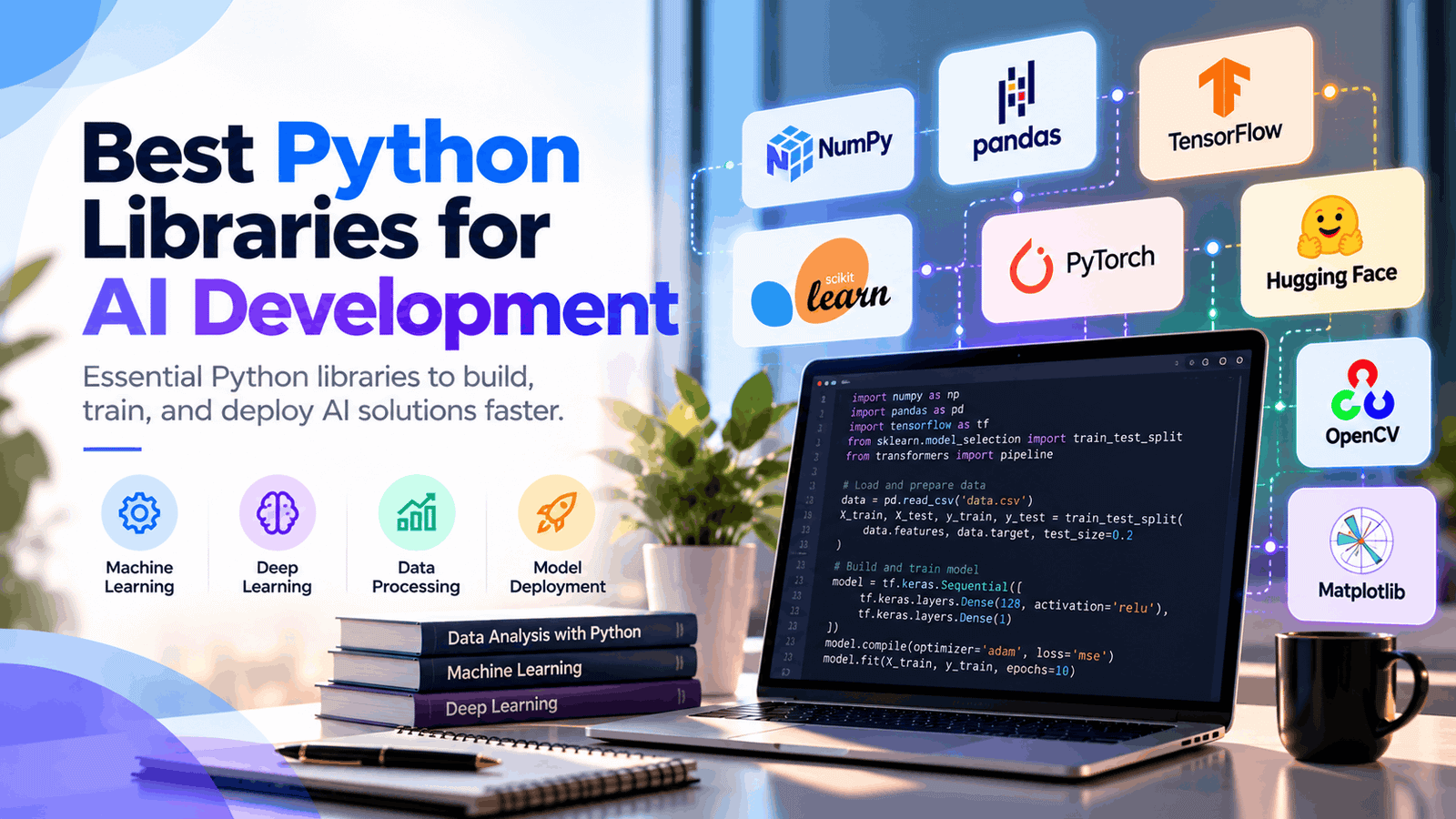
Artificial intelligence is transforming how businesses build software, analyze data, and automate workflows. Python remains one of the most popular languages for AI development because of its extensive ecosystem of libraries for machine learning, deep learning, data processing, and generative AI. <Cite refs={[“turn582245search0″,”turn582245search3”]}/>
Whether you’re developing AI agents, chatbots, predictive models, or computer vision applications, choosing the right Python libraries can simplify development and improve performance.
In this guide, we’ll explore the best Python libraries for AI development in 2026 and explain when to use each one.
1. PyTorch — Best for Deep Learning
PyTorch is an open-source deep learning framework widely used to develop and train neural networks. Its flexible, Python-friendly approach makes it suitable for experimentation and advanced AI projects.
Key features:
- Neural network development and training.
- GPU acceleration.
- Computer vision and natural language processing.
- Support for custom AI architectures.
Best for: Deep learning, research, and custom AI model development.
2. TensorFlow — Best for Production AI
TensorFlow provides tools for building, training, and deploying machine learning models. Its ecosystem supports applications ranging from image recognition to large-scale predictive systems.
Key features:
- Deep learning and neural networks.
- Distributed model training.
- Deployment tools for different environments.
- Integration with Keras for model development.
Best for: Production-oriented AI applications and scalable machine learning systems.
3. Scikit-learn — Best for Traditional Machine Learning
Scikit-learn is a popular Python library for classical machine learning. It provides algorithms and utilities for training models without requiring the complexity of deep learning frameworks.
Key features:
- Classification and regression.
- Clustering and dimensionality reduction.
- Data preprocessing.
- Model evaluation and cross-validation.
Best for: Predictive analytics, customer segmentation, fraud detection, and structured business data.
4. Hugging Face Transformers — Best for Generative AI
Hugging Face Transformers provides access to pretrained models for language, vision, audio, and multimodal applications.
Instead of training every model from scratch, developers can use existing models and adapt them to specific tasks.
Key features:
- Access to pretrained AI models.
- Text generation and summarization.
- Question answering and classification.
- Model fine-tuning and evaluation.
Best for: Large language models (LLMs), generative AI, and natural language processing.
5. LangChain — Best for AI Applications and Agents
LangChain helps developers build applications that use large language models and external tools. It can connect models with APIs, data sources, and workflow components.
Key features:
- LLM application development.
- Tool calling and agent workflows.
- Integration with external data sources.
- Support for retrieval-augmented generation (RAG).
Best for: AI assistants, chatbots, and tool-using AI agents. For complex, stateful agent workflows, developers can also explore LangGraph.
6. NumPy — Best for Numerical Computing
NumPy provides efficient arrays and mathematical operations that form the foundation of many scientific computing and AI workflows.
Key features:
- Fast multidimensional arrays.
- Mathematical and statistical operations.
- Data manipulation.
- Integration with machine learning libraries.
Best for: Numerical calculations, scientific computing, and preparing data for AI models.
7. Pandas — Best for Data Preparation
Pandas helps developers clean, organize, transform, and analyze structured data before using it to train or evaluate AI models.
Key features:
- Data cleaning and transformation.
- Handling missing values.
- Working with CSV and spreadsheet files.
- Data analysis and aggregation.
Best for: Data preprocessing, business analytics, and preparing datasets for machine learning.
8. OpenCV — Best for Computer Vision
OpenCV is a computer vision library used to process and analyze images and videos. It provides tools for building applications that interpret visual information.
Key features:
- Image processing and enhancement.
- Object and feature detection.
- Video analysis.
- Integration with deep learning models.
Best for: Image recognition, visual inspection, video analytics, and computer vision applications.
9. XGBoost — Best for Predictive Analytics
XGBoost is a machine learning library that uses gradient-boosted decision trees. It is particularly effective for many structured-data problems.
Key features:
- Classification and regression.
- Efficient model training.
- Support for missing data.
- Useful feature importance analysis.
Best for: Sales forecasting, risk scoring, customer churn prediction, and other tabular-data tasks.
10. FastAPI — Best for Deploying AI Applications
FastAPI is a Python web framework for building APIs. It helps developers make trained models and AI-powered applications accessible to websites, mobile apps, and other services.
Key features:
- High-performance API development.
- Automatic API documentation.
- Input validation.
- Integration with Python AI libraries.
Best for: Deploying AI models, creating AI-powered web services, and connecting AI systems to business applications.
Comparison: Which Python AI Library Should You Choose?
| Library | Primary Purpose | Ideal Use Case |
|---|---|---|
| PyTorch | Deep learning | Custom neural networks |
| TensorFlow | Machine learning and deployment | Production AI |
| Scikit-learn | Classical machine learning | Predictive analytics |
| Hugging Face Transformers | Pretrained models | Generative AI and NLP |
| LangChain | LLM application orchestration | AI agents and chatbots |
| NumPy | Numerical computing | Mathematical operations |
| Pandas | Data processing | Dataset preparation |
| OpenCV | Computer vision | Image and video analysis |
| XGBoost | Gradient boosting | Structured-data prediction |
| FastAPI | API development | Deploying AI applications |
How to Choose the Right Python Library
The best library depends on your project’s goals.
- For beginners: Start with NumPy, Pandas, and Scikit-learn.
- For deep learning: Explore PyTorch or TensorFlow.
- For generative AI: Use Hugging Face Transformers.
- For AI agents: Consider LangChain and LangGraph.
- For predictive analytics: Try Scikit-learn or XGBoost.
- For AI deployment: Use FastAPI to expose your model through an API.
Many projects combine multiple libraries rather than relying on a single tool. For example, a business forecasting application might use Pandas for data preparation, XGBoost for predictions, and FastAPI to deliver results to a dashboard.
Conclusion
Python offers a powerful ecosystem for AI development in 2026. From PyTorch and TensorFlow to Hugging Face and LangChain, each library serves a different purpose across the AI development lifecycle.
The best approach is to select libraries based on your use case, technical requirements, and deployment needs. Start with a focused project, build a working prototype, and expand your technology stack as your requirements grow.
Looking to build AI-powered business solutions? Profilent can help you explore AI development and automation opportunities tailored to your business needs.