Introduction
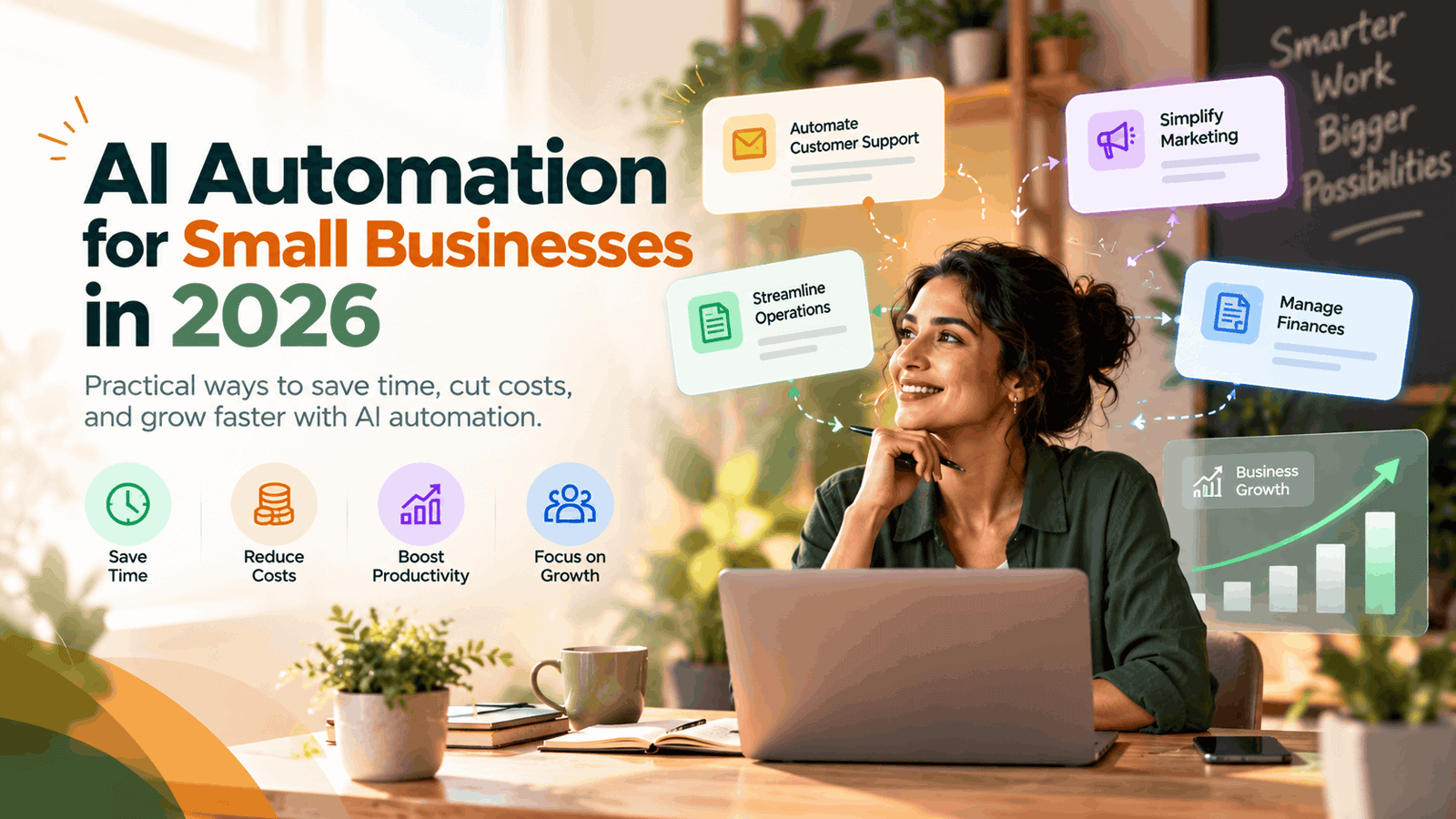
Running a small business in 2026 means balancing customer expectations, rising operating costs, limited resources, and increasing competition. Owners often spend hours answering routine questions, following up with prospects, updating spreadsheets, preparing reports, and managing administrative work instead of focusing on business growth.
AI automation for small businesses offers a practical way to address these challenges. By combining artificial intelligence with automated workflows, companies can handle repetitive activities faster, organize information more effectively, and help employees concentrate on work that requires human judgment.
Unlike traditional automation, which follows predefined rules, AI-powered systems can interpret text, classify information, summarize documents, recognize patterns, and assist with decisions. When connected to business applications, these capabilities can support complete workflows rather than isolated tasks.
However, successful implementation does not mean automating everything at once. The best approach is to identify recurring problems, select suitable tools, and measure whether automation delivers meaningful results.
This guide explores the benefits, practical applications, popular tools, implementation steps, and challenges of AI automation for small businesses in 2026.
What Is AI Automation for Small Businesses?
AI automation combines artificial intelligence technologies with software workflows to reduce manual effort across business operations.
Traditional automation performs predictable actions when specific conditions are met. For example, an email platform might automatically send a confirmation after someone submits a contact form.
AI-powered automation can go further. It might analyze the inquiry, identify the customer’s needs, categorize the request, draft a personalized response, and send the information to the appropriate team member for review.
Common technologies include:
- Generative AI: Creates and summarizes text, images, reports, and other content.
- Workflow automation: Connects applications and moves information between them.
- AI chatbots: Respond to common questions and help customers find information.
- Predictive analytics: Examines historical data to identify patterns and support forecasting.
- AI agents: Can pursue defined objectives through multiple steps, use connected tools, and respond to intermediate results within established permissions.
For a small company, these technologies can work together to streamline sales, marketing, customer support, finance, and everyday administration without requiring a large technology department.
Why AI Automation Matters in 2026
AI adoption is becoming increasingly relevant to smaller organizations, although the level of implementation varies across industries and countries.
The Organisation for Economic Co-operation and Development (OECD), in its 2025 survey of more than 5,000 small and medium-sized enterprises across seven countries, found that 31% of surveyed SMEs were using generative AI. Among businesses using the technology, 65% reported improved employee performance, while 45.2% said it helped reduce costs. These are survey findings, not guaranteed outcomes for every business. Source: OECD, Generative AI and the SME Workforce.
The findings highlight an important opportunity: smaller companies can use AI to strengthen existing teams rather than simply increase headcount.
Another 2025 report from the U.S. Chamber of Commerce found that AI use among surveyed small businesses increased from 40% in 2024 to 58% in 2025. The report also identified customer engagement and inventory management among common applications. Because surveys use different definitions of AI adoption, these figures should not be compared directly with the OECD estimate. Source: U.S. Chamber of Commerce, Empowering Small Business.
For business owners, the message is straightforward: AI is becoming easier to access, but the greatest value comes from applying it to specific operational needs.
7 Practical AI Automation Use Cases for Small Businesses
1. Customer Support and Inquiry Management
Responding to customer questions can consume a significant portion of a small team’s day. AI chatbots can answer frequently asked questions about products, services, delivery policies, appointment availability, and business hours.
A connected system can categorize incoming messages, suggest responses, and direct complicated issues to a human representative.
For example, a local service company could automatically answer routine questions about service coverage while forwarding complaints or unusual requests to its support team.
Business benefit: Faster initial responses, more consistent communication, and fewer repetitive support tasks.
Businesses should clearly identify automated interactions and provide an easy way to contact a person when needed.
2. Marketing Content and Campaign Automation
Small businesses often struggle to publish content consistently because marketing competes with daily operational responsibilities.
AI writing tools can help develop blog outlines, email drafts, product descriptions, social media captions, and campaign variations. Workflow automation can then schedule approved content, organize assets, and collect performance data.
For example, an agency could turn an approved article into a newsletter draft and several social media posts, followed by a human review before publication.
AI-generated content should be checked for accuracy, originality, brand consistency, and search intent. Publishing large volumes of unreviewed material can undermine trust and content quality.
Business benefit: More efficient content production and better coordination across marketing channels.
3. Lead Qualification and Sales Follow-Ups
Sales opportunities can be lost when inquiries remain unanswered or follow-ups are delayed.
AI automation can collect information from contact forms, categorize leads based on stated needs, update a customer relationship management (CRM) system, and prepare personalized follow-up messages.
A consultancy, for instance, could route enterprise inquiries to a senior salesperson while directing general questions to an appropriate team member.
The system should use transparent qualification criteria and avoid making consequential decisions based on unreliable assumptions.
Business benefit: Better lead organization, fewer missed follow-ups, and improved visibility into the sales pipeline.
4. Invoice Processing and Financial Administration
Financial administration involves recurring activities such as organizing invoices, extracting payment details, tracking due dates, and reconciling transaction records.
AI-enabled document processing can extract information from invoices and receipts, classify expenses, and flag missing or inconsistent details. Automation tools can transfer approved information into accounting software and remind customers about outstanding payments.
For example, a small distributor could automatically capture supplier invoice details and prepare them for approval before the accounting team records the transaction.
Financial entries, tax calculations, refunds, and payments should retain appropriate approval controls.
Business benefit: Less manual data entry, more organized records, and faster identification of discrepancies.
5. Inventory Monitoring and Demand Forecasting
Retailers and product-based businesses must balance stock availability against storage costs and changing customer demand.
AI-assisted analytics can examine historical sales, seasonal patterns, and current inventory to identify potential shortages or unusual movements. Automated notifications can alert staff when products approach predefined reorder thresholds.
A small online store might receive a daily report showing fast-selling products, low-stock items, and products requiring further review.
Forecasts are only as reliable as their underlying data, so owners should account for supplier delays, promotions, and unexpected changes in demand.
Business benefit: Better inventory visibility, more informed purchasing, and fewer avoidable stock problems.
6. Appointment Scheduling and Administrative Workflows
Businesses that rely on consultations, bookings, or service appointments can automate confirmation messages, reminders, rescheduling requests, and post-appointment follow-ups.
For example, a consulting firm can connect its booking calendar to email notifications and a CRM. When an appointment is scheduled, the system sends confirmation, creates a record, and reminds the customer before the meeting.
AI can also summarize meeting notes and identify follow-up tasks, subject to appropriate consent and privacy practices.
Business benefit: Fewer administrative interruptions and a more consistent customer experience.
7. Internal Knowledge and Document Management
Small teams frequently store information across shared folders, email threads, project tools, and documents. Finding the latest policy, proposal, or project update can take longer than expected.
An AI-powered knowledge assistant can search approved internal documents, summarize relevant information, and direct employees to source materials.
A marketing agency, for example, could use a controlled knowledge base to retrieve brand guidelines, approved service descriptions, and project procedures.
Access permissions matter: employees should only receive information they are authorized to view, and sensitive documents should not be sent to unapproved AI services.
Business benefit: Faster information retrieval, improved knowledge sharing, and less time spent searching through files.
Features, plans, usage limits, and integrations change over time, so verify current vendor documentation before committing.
Businesses do not necessarily need six separate subscriptions. Start with tools that integrate with existing systems, and add new platforms only when they solve a clearly defined problem.