
Organizations across industries are investing in AI to improve productivity, automate processes, enhance customer experiences, and make data-driven decisions. However, while enthusiasm for AI is high, many initiatives fail to move beyond pilot projects because organizations lack a structured implementation strategy.
For Chief Information Officers (CIOs), the challenge is no longer deciding whether to adopt AI—it is determining how to implement it responsibly, securely, and at scale. A successful AI program requires more than selecting the right tools; it demands alignment between business objectives, technology, governance, data, and people.
This roadmap outlines a practical framework that CIOs can use to build a scalable AI strategy and maximize long-term business value.
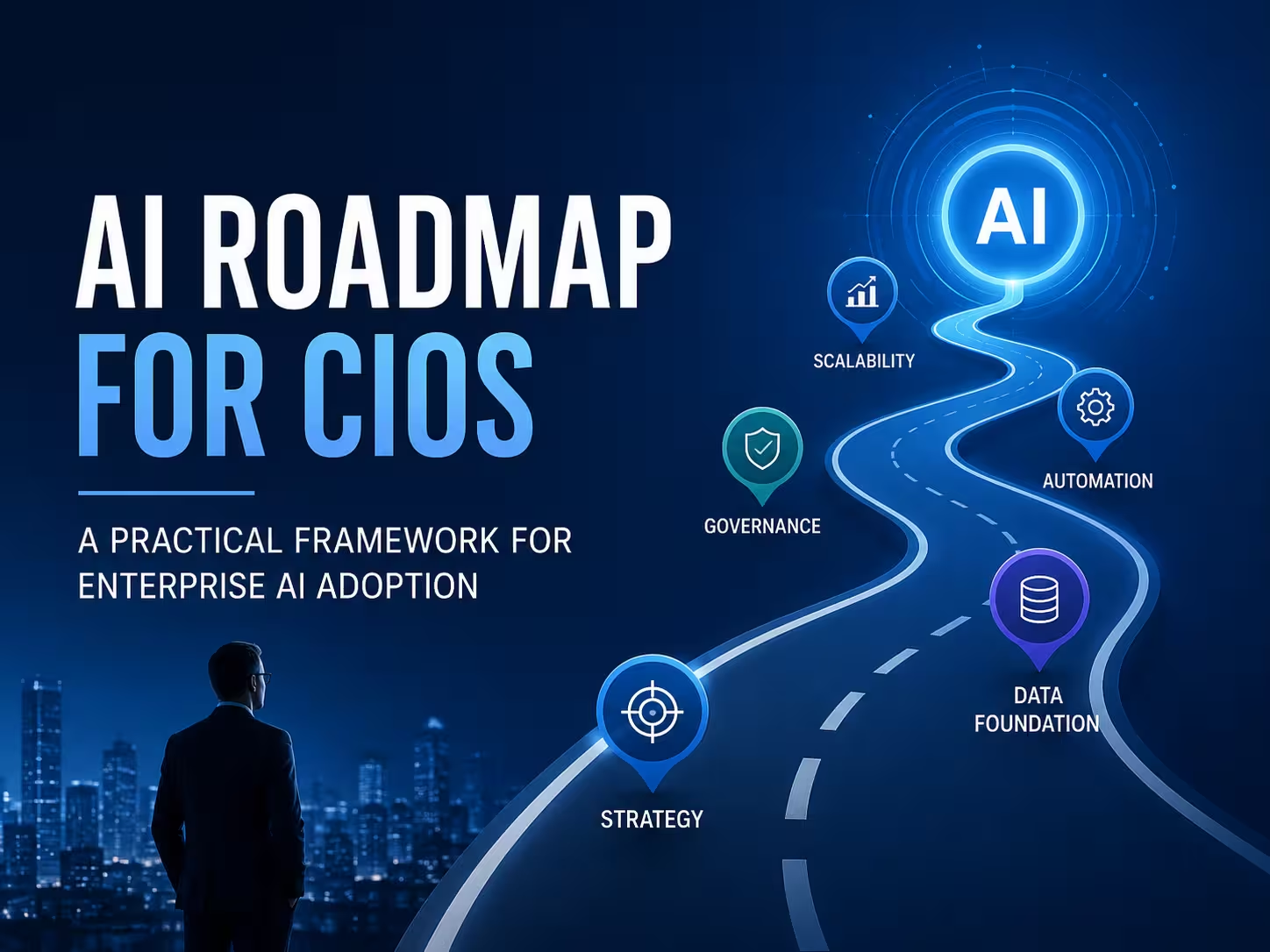
Why CIOs Need an AI Roadmap
Many organizations begin their AI journey with isolated experiments—an AI chatbot for customer service, a document processing solution in finance, or a pilot project in marketing. While these initiatives demonstrate potential, they often remain disconnected and fail to deliver enterprise-wide transformation.
An AI roadmap provides a structured approach that helps organizations:
- Align AI investments with business priorities
- Identify high-value automation opportunities
- Reduce implementation risks
- Ensure regulatory compliance
- Build a scalable technology foundation
- Measure return on investment consistently
Without a roadmap, AI initiatives risk becoming fragmented, expensive, and difficult to govern.
Phase 1: Define the Business Vision
Every successful AI initiative starts with a business problem—not a technology purchase.
CIOs should work closely with executive leadership to answer key questions:
- Which business objectives should AI support?
- Where are the biggest operational inefficiencies?
- Which customer experiences require improvement?
- What competitive advantages can AI create?
Instead of asking, “Where can we use AI?” ask, “Which business outcomes matter most?”
Examples of strategic objectives include reducing operational costs, improving employee productivity, accelerating decision-making, increasing customer satisfaction, and creating new revenue opportunities.
Phase 2: Assess AI Readiness
Before investing in AI platforms, organizations should evaluate their current capabilities.
An enterprise AI readiness assessment typically covers:
- Data quality and accessibility
- Cloud infrastructure
- Security architecture
- Existing automation platforms
- Integration capabilities
- Governance policies
- Workforce readiness
- Executive sponsorship
Many organizations discover that improving data quality and system integration delivers more value than purchasing additional AI tools.
Phase 3: Identify High-Impact Use Cases
Not every business process should be automated. CIOs should prioritize initiatives that deliver measurable value within six to twelve months.
High-impact AI opportunities often include:
- Customer support automation
- Intelligent document processing
- IT service management
- HR recruitment
- Finance and invoice processing
- Sales enablement
- Enterprise knowledge management
- Predictive maintenance
- Compliance monitoring
Evaluate each use case based on business value, implementation complexity, technical feasibility, and expected return on investment.
Phase 4: Build a Secure Data Foundation
AI is only as effective as the data it uses.
Organizations should establish a reliable data foundation by:
- Eliminating duplicate records
- Standardizing business data
- Defining ownership and stewardship
- Implementing data governance policies
- Securing sensitive information
- Integrating enterprise systems
A well-governed data environment improves AI accuracy while reducing security and compliance risks.
Phase 5: Select the Right AI Architecture
Rather than deploying isolated AI applications, CIOs should design an enterprise architecture that supports long-term scalability.
Key architectural components include:
- Enterprise data platform
- API integration layer
- AI model management
- Workflow orchestration
- Identity and access management
- Monitoring and observability
- Security and compliance controls
A modular architecture enables organizations to adopt new AI capabilities without disrupting existing systems.
Phase 6: Establish AI Governance
As AI becomes embedded in business operations, governance becomes essential.
An effective governance framework should define:
- Responsible AI principles
- Data privacy standards
- Human approval requirements
- Risk classification
- Audit logging
- Model monitoring
- Bias detection
- Regulatory compliance
Governance should accelerate innovation by providing clear guardrails rather than creating unnecessary bureaucracy.
Phase 7: Launch Pilot Projects
Instead of attempting enterprise-wide transformation immediately, CIOs should begin with focused pilot initiatives.
Ideal pilot projects share several characteristics:
- Clear business objectives
- Executive sponsorship
- Measurable success metrics
- Limited implementation scope
- Available data
- Cross-functional collaboration
Successful pilots create confidence, demonstrate value, and establish reusable implementation patterns.
Phase 8: Scale Through Intelligent Automation
Once pilot projects demonstrate measurable outcomes, organizations can expand AI adoption across departments.
This phase often involves combining AI with automation platforms to orchestrate complete business workflows.
Examples include:
- Employee onboarding
- Procurement approval
- Customer complaint resolution
- Contract lifecycle management
- Financial reconciliation
- Compliance reporting
Scaling should focus on improving end-to-end business processes rather than automating isolated tasks.
Phase 9: Measure Business Outcomes
Technology metrics alone do not demonstrate AI success.
CIOs should track business-focused KPIs such as:
- Reduction in process cycle time
- Employee productivity improvements
- Customer satisfaction scores
- Operational cost savings
- Error reduction
- Compliance improvements
- Revenue growth
- Time-to-market acceleration
Regular performance reviews help organizations refine AI strategies and prioritize future investments.
Phase 10: Build an AI-Ready Culture
Technology adoption succeeds only when employees understand how AI supports their work.
Organizations should invest in:
- AI awareness programs
- Role-specific training
- Change management initiatives
- Cross-functional collaboration
- Citizen development programs
- Continuous learning opportunities
The objective is to empower employees to work alongside AI rather than perceive it as a replacement.
Common Pitfalls CIOs Should Avoid
Several common mistakes can limit the success of enterprise AI initiatives:
- Starting with technology instead of business objectives
- Pursuing too many AI projects simultaneously
- Ignoring data quality issues
- Underestimating governance requirements
- Failing to involve business stakeholders
- Measuring activity instead of business outcomes
- Neglecting employee adoption and training
Recognizing these challenges early allows organizations to build a stronger foundation for long-term success.
The Future of Enterprise AI
Enterprise AI is moving beyond isolated assistants toward intelligent ecosystems where multiple AI agents collaborate across departments, automate complex workflows, and support decision-making at scale.
Future-ready organizations will integrate AI into their core operating model rather than treating it as a standalone initiative. This requires a strategic roadmap that balances innovation with governance, agility with security, and automation with human oversight.
Conclusion
Artificial Intelligence is no longer a technology experiment—it is becoming a core capability for modern enterprises. CIOs have a unique opportunity to lead this transformation by creating an AI strategy that aligns with business priorities, strengthens operational resilience, and delivers measurable value.
Organizations that begin with a clear vision, invest in strong data foundations, establish governance early, and scale through carefully selected use cases will be best positioned to realize the full potential of AI. The most successful AI journeys are not defined by the number of tools deployed but by the business outcomes achieved.
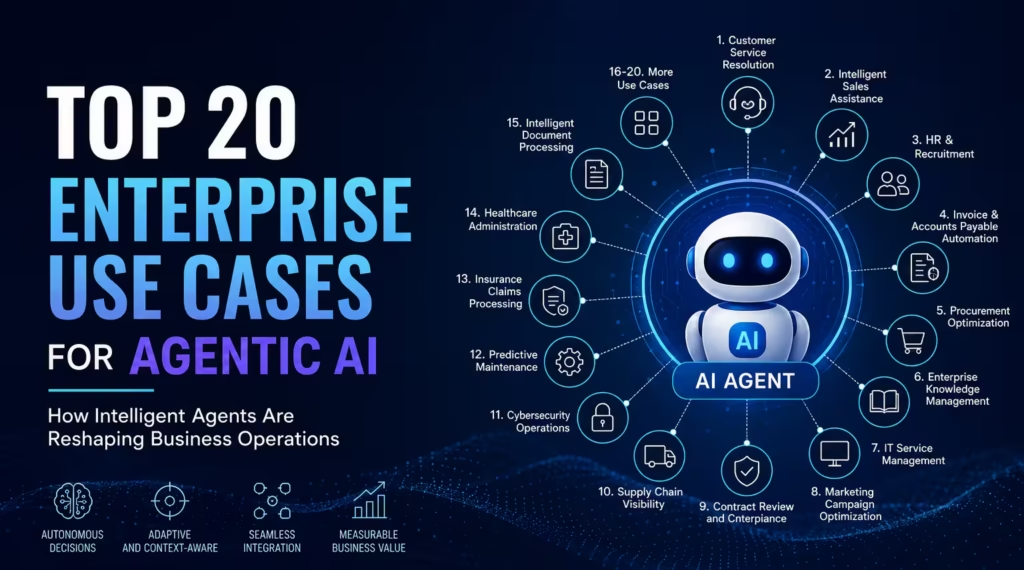
Top 20 Enterprise Use Cases for Agentic AI
While the first wave of AI focused on generating content, answering questions, and assisting employees, the next wave is about taking action. This evolution is known as Agentic AI—intelligent systems capable of planning, reasoning, making decisions, and executing complex business workflows with minimal human intervention. Unlike traditional automation, which follows predefined rules, Agentic AI adapts […]
AI Roadmap for CIOs | Enterprise AI Strategy & Adoption Guide
Organizations across industries are investing in AI to improve productivity, automate processes, enhance customer experiences, and make data-driven decisions. However, while enthusiasm for AI is high, many initiatives fail to move beyond pilot projects because organizations lack a structured implementation strategy. For Chief Information Officers (CIOs), the challenge is no longer deciding whether to adopt […]
AI Workforce Management for Enterprise Leaders
For decades, workforce management has focused on people—hiring, training, scheduling, performance management, and employee engagement. As Artificial Intelligence becomes embedded into everyday business operations, a new challenge is emerging: organizations must now manage not only human employees but also intelligent AI agents, automation workflows, and digital assistants. This shift marks the beginning of AI Workforce […]