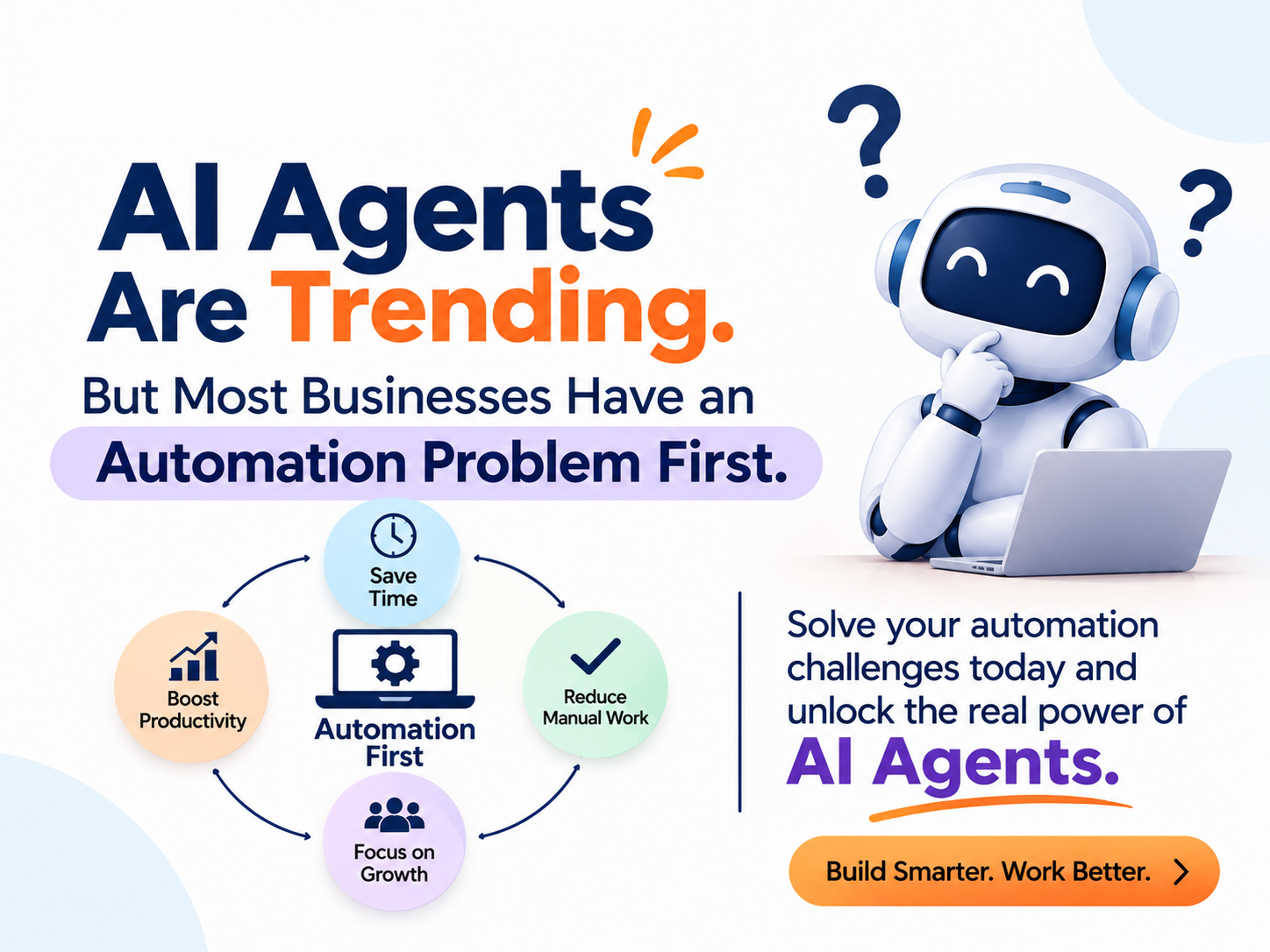
Artificial intelligence has revolutionized the way businesses run. Customer support services to the management of sales campaigns are some of the areas where agents of AI are gaining popularity. Companies are looking for ways that intelligent systems can take up repetitive tasks, enhance customer experience, and help in decision-making.
A lot of organizations wish to have agents of AI that will engage with the customers, qualify leads, conduct workflow management, and conduct business activities automatically. But what businesses tend to forget is that AI cannot cure an ill business process just by being there.
If you have all your data distributed among various channels and your people have to manually transfer data from one tool to another, and critical follow-up depends upon people not forgetting about them, then having AI agents could bring more complications than solve them.
Before jumping into advanced AI solutions, businesses need to know their problems with automation.
What Are AI Agents and Why All That Buzz About Them?
AI agents are smart systems able to comprehend commands, analyze data and complete tasks with some level of autonomy. As opposed to conventional automation, which is based on pre-defined rules, AI agents are able to apply context analysis to deal with a particular situation and decide how to act in accordance with their responsibilities.
Businesses have found AI agents useful for such tasks as:
Supporting customers: responding to frequently asked questions and providing relevant information.
Qualifying leads: gathering information about customers, analyzing their needs and finding leads.
Managing workflow: coordinating processes within various business applications.
Analyzing documents: extracting, organizing and processing information.
Supporting sales: completing follow-ups, managing customer files and other sales tasks.
However, the efficiency of the work of such systems strongly depends on the quality of processes, information and systems used by companies.
The Main Issue: Automation Challenges of Businesses
Companies think that using AI is the quickest way to increase productivity. But the main problems of many businesses are disconnections between systems and inefficiencies in their workflows.
This process results in the following challenges:
1. Customer Data Is Distributed Over Various Platforms
The data of customers is usually collected in spreadsheets, email programs, CRM systems, etc. If such platforms are not connected, employees spend time looking through different sources for information and updating it.
2. Employees Engage in Repetitive Tasks
Employees from sales and operations departments spend much time copying information, updating the records, compiling reports, and executing various other tasks which consume time that could be devoted to other work activities.
3. Lead Follow-Up Relies on Reminders to Staff Members
If lead follow-up relies on sending reminders for employees about the necessity to call customers or send them messages, some opportunities might be lost due to lack of a structured process.
4. There Is Lack of Workflow Visibility
If responsibilities and stages of task execution are not defined, managers will have difficulties understanding what goes on, who is responsible, and where there are some delays in the process.
Implementation of the AI agent into such a process will not make the company more efficient because of the problems described above.
Why AI Cannot Solve the Problem of Poor Workflow
Now, let’s consider the introduction of an AI agent responsible for dealing with customer queries. The AI agent is supposed to gather information, qualify leads, fill out the CRM system, and make follow-up arrangements.
However, how will the AI agent perform its tasks if the CRM system does not have enough information about customers? How about the lack of clarity in lead allocation processes or the use of various application solutions in separate departments?
That is why companies cannot begin their AI experience by asking themselves “What tasks can be performed with the help of AI agents?”
They should ask:
What is the process that should be improved first?
And only after answering this question, companies can build a workflow based on AI.
Foundation for Effective AI Implementation
Four foundations need to be set before introducing AI agents to business processes.
1. Clean and Structured Data
Good data is fundamental to automation. Businesses need to structure their customer information, eliminate duplication, keep their databases updated, and implement good data practices.
Automation systems can then access the proper information and execute tasks effectively when data is structured.
2. Integration of Business Applications
Business applications need to be interconnected as much as possible. Integrations of CRMs, emails, marketing, and internal applications cut down on manual data entry.
For instance, if a customer raises an inquiry via the website, it should be automatically forwarded to the CRM and inform the concerned sales executive.
3. Good Workflows
All processes in a business need to be structured.
Prior to automating a workflow, the following things need to be established:
– What needs to be done?
– When does it need to be done?
– Who needs to do it?
– What system is going to execute the task?
– What happens in case of any problems?
4. The Right Level of AI
Every type of work does not necessarily require artificial intelligence.
If your task involves rule-based actions like notifications, record updates, and lead assignments, then using traditional automation will be a more effective solution.
On the other hand, AI will work best on tasks that need interpretation of data, understanding of customer messages, dealing with various scenarios, and providing recommendations based on the context.
Right selection of tools for every particular action is critical to reducing complications and expenses for implementation.
Traditional Automation vs. AI Agents: What Does Your Business Need?
Both types of automation have their own place in modern business operations.
The traditional automation operates according to preset conditions and instruction sets. Such type of automation is suitable for processes that involve repetition and predictable results.
While AI agents may take care of those tasks that need understanding of the context and flexible decisions within preset boundaries.
For example:
Notification of appointment confirmation: Traditional automation.
Customer appointment request interpretation: AI agent.
Updating the CRM after form fill-in: Traditional automation.
Customer message analysis and determination of its requirements: AI agent.
Reminder sending: Traditional automation.
Complex question answering from customers: AI agent, with proper protection
How Profilent Assists Businesses to Create Better Automation Systems
Here at Profilent, we understand that the process of digital transformation should start with knowing what challenges the business faces and creating the proper technological base.
Being the company that creates AI and automation solutions, Profilent assists businesses with improving their processes by developing customized AI applications, AI agents, workflow automation and no-code development.
The focus of our activities lies in developing pragmatic approaches to solving business issues.
We assist businesses to:
Identify repeated tasks and automate them.
Develop customized workflows according to the needs of the business.
Connect different applications and business systems.
Create AI applications and agents.
Automate and make processes more efficient.
Develop scalable automation solutions.