
Artificial Intelligence is evolving at an astonishing pace, and Python continues to dominate the ecosystem behind it. From startups building AI assistants to enterprises deploying machine learning systems at scale, Python has become the preferred language for intelligent applications.
One major reason is its extraordinary library ecosystem.
Instead of building complex algorithms from scratch, developers can leverage mature frameworks that simplify everything from neural networks to natural language processing.
Here are the most impactful Python libraries shaping AI development in 2026.
1. TensorFlow
TensorFlow remains one of the most influential deep learning frameworks in the industry.
Originally developed by Google, it powers:
- recommendation engines
- image recognition systems
- large-scale AI models
- enterprise machine learning pipelines
Its flexibility makes it suitable for both research and production environments.
Best For:
- Deep learning
- Neural networks
- Large-scale AI systems
2. PyTorch
PyTorch has become exceptionally popular among researchers and developers because of its elegant syntax and dynamic computation graphs.
Many modern AI breakthroughs are prototyped using PyTorch due to its developer-friendly architecture.
Why Developers Prefer It:
- easier debugging
- intuitive workflows
- strong community support
Today, several leading AI labs rely heavily on PyTorch for experimentation.
3. Scikit-learn
Not every AI project requires massive neural networks.
Scikit-learn excels at:
- regression
- classification
- clustering
- predictive analytics
Its simplicity makes it ideal for beginners entering machine learning.
In fact, many business analytics solutions still depend on traditional ML models rather than deep learning.
4. Hugging Face Transformers
Natural Language Processing has transformed dramatically over the last few years, and Hugging Face sits at the center of this revolution.
The library provides access to thousands of pre-trained AI models for:
- chatbots
- summarization
- translation
- sentiment analysis
- content generation
It significantly reduces development time for NLP projects.
5. Pandas
AI systems are only as good as their data.
Pandas simplifies:
- data cleaning
- manipulation
- transformation
- analysis
Before training a model, developers often spend nearly 80% of their time preparing datasets. Pandas helps streamline that process efficiently.
6. OpenCV
Computer vision applications continue to grow rapidly across healthcare, security, retail, and autonomous systems.
OpenCV enables machines to:
- detect faces
- process images
- identify objects
- analyze video streams
It remains one of the most widely used computer vision libraries globally.
7. LangChain
As AI agents and autonomous workflows become mainstream, LangChain has emerged as a vital framework for connecting LLMs with tools, APIs, and memory systems.
It’s particularly useful for:
- AI agents
- workflow automation
- RAG systems
- conversational AI
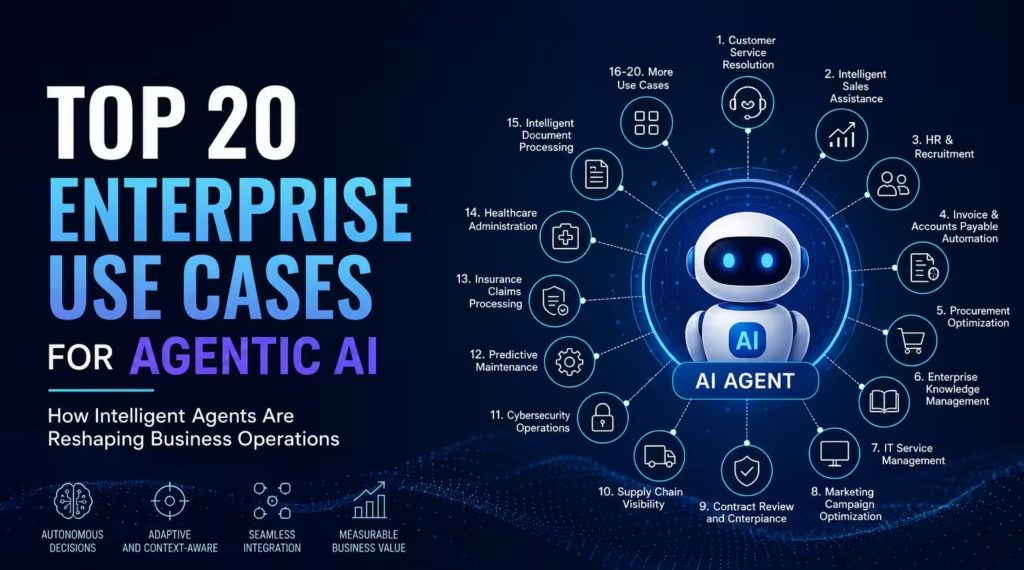
Top 20 Enterprise Use Cases for Agentic AI
While the first wave of AI focused on generating content, answering questions, and assisting employees, the next wave is about taking action. This evolution is known as Agentic AI—intelligent systems capable of planning, reasoning, making decisions, and executing complex business workflows with minimal human intervention. Unlike traditional automation, which follows predefined rules, Agentic AI adapts […]
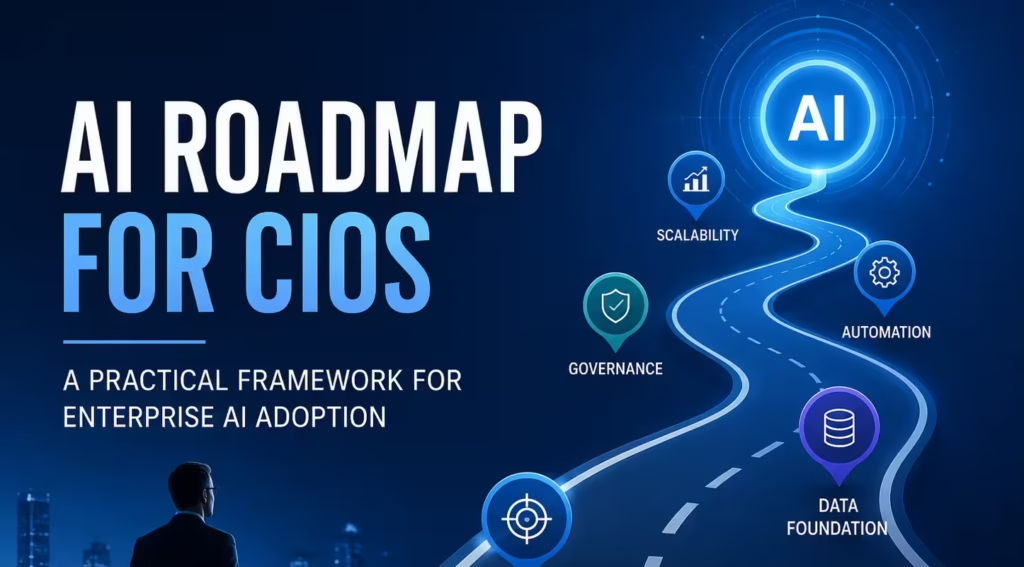
AI Roadmap for CIOs | Enterprise AI Strategy & Adoption Guide
Organizations across industries are investing in AI to improve productivity, automate processes, enhance customer experiences, and make data-driven decisions. However, while enthusiasm for AI is high, many initiatives fail to move beyond pilot projects because organizations lack a structured implementation strategy. For Chief Information Officers (CIOs), the challenge is no longer deciding whether to adopt […]
AI Workforce Management for Enterprise Leaders
For decades, workforce management has focused on people—hiring, training, scheduling, performance management, and employee engagement. As Artificial Intelligence becomes embedded into everyday business operations, a new challenge is emerging: organizations must now manage not only human employees but also intelligent AI agents, automation workflows, and digital assistants. This shift marks the beginning of AI Workforce […]