
Artificial Intelligence has become one of the most talked-about technologies in business.
Organizations across industries are exploring ways to improve efficiency, streamline operations, and gain a competitive advantage through AI. However, while many businesses are eager to adopt AI, not all implementations deliver the expected results.
The difference often comes down to strategy.
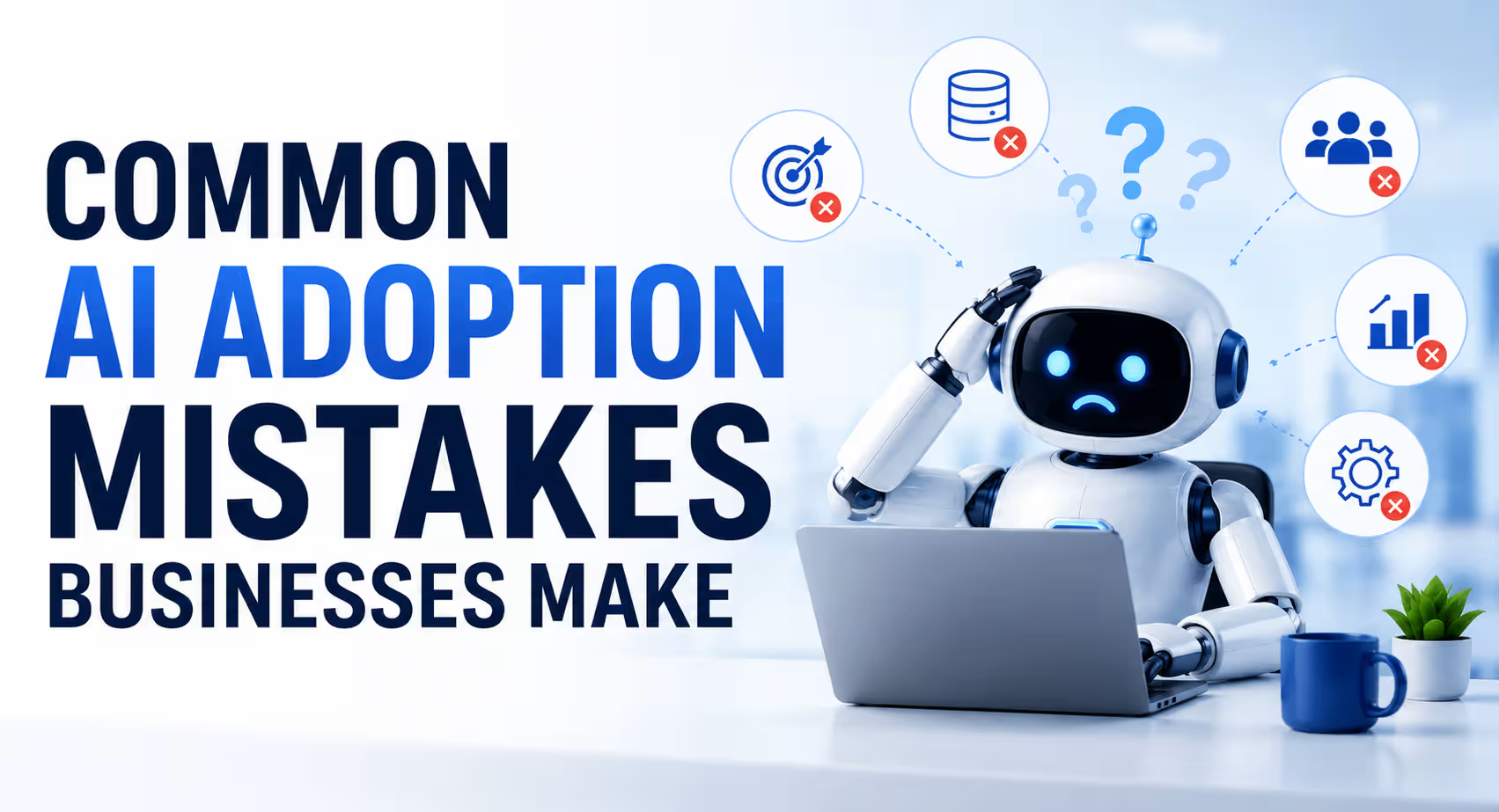
Successful organizations view AI as a business initiative. Unsuccessful ones often treat it as a technology project.
If you’re considering AI for your business, here are some of the most common mistakes to avoid.
Starting With Technology Instead of Business Problems
One of the biggest mistakes businesses make is adopting AI simply because it’s popular.
Instead of asking, “How can we use AI?” the better question is:
“What business challenge are we trying to solve?”
The most successful AI initiatives focus on specific problems such as:
Reducing administrative workload
Improving customer service
Enhancing operational efficiency
Increasing productivity
Improving decision-making
When AI is tied directly to business objectives, the value becomes much easier to measure.
Trying to Automate Everything at Once
Many organizations become excited about the possibilities and attempt to automate multiple processes simultaneously.
This often creates unnecessary complexity and increases the risk of failure.
A better approach is to start with a single process that:
Is repetitive
Consumes significant time
Has clear measurable outcomes
Creates operational bottlenecks
Small wins build confidence and provide valuable lessons for future projects.
Ignoring Existing Processes
AI cannot fix a broken process.
If a workflow is inefficient today, introducing AI without improving the process may simply automate the inefficiency.
Before implementing any solution, businesses should review how work is currently being performed and identify opportunities to simplify processes first.
The most successful projects combine process improvement with technology.
Expecting Immediate Results
AI implementation is not a magic switch.
Like any business initiative, it requires planning, testing, optimization, and continuous improvement.
Organizations that expect immediate transformation often become disappointed when results take time to materialize.
The businesses that achieve the greatest value view AI as a long-term capability rather than a short-term experiment.
Overlooking Employee Adoption
Technology alone does not create success.
People play a critical role.
One of the most common reasons projects struggle is because employees are not properly involved in the process.
Teams need to understand:
Why the solution is being implemented
How it supports their work
What benefits it provides
How to use it effectively
When employees feel included, adoption becomes significantly easier.
Choosing Tools Before Defining Requirements
The market is full of AI platforms, automation tools, and intelligent applications.
Many businesses begin by evaluating software before clearly defining what they need.
This often leads to selecting solutions that don’t align with business requirements.
The better approach is to:
Identify the problem.
Define the desired outcome.
Document requirements.
Evaluate technology options.
Technology should support the strategy, not define it.
Focusing Only on Cost Savings
While reducing costs is important, it’s rarely the only benefit.
Many successful AI initiatives also deliver:
Faster response times
Improved customer experiences
Better data visibility
Increased employee productivity
Enhanced scalability
Organizations that focus solely on cost reduction often overlook larger opportunities for growth and innovation.
Neglecting Data Quality
AI systems rely on information to generate useful outputs.
If data is incomplete, outdated, inconsistent, or inaccurate, results will suffer.
Businesses should assess their data quality before launching significant AI initiatives.
Clean, organized data creates a much stronger foundation for success.
Treating AI as a One-Time Project
AI is not a destination.
It’s an ongoing capability.
Business needs evolve, customer expectations change, and processes improve over time.
Organizations that continuously refine and expand their AI initiatives often achieve significantly greater long-term value than those that view implementation as a one-time activity.
Building a Smarter Approach to AI Adoption
AI has the potential to deliver substantial business value when implemented strategically.
The organizations seeing the best results are not necessarily investing the most money or using the most advanced technologies.
They are focusing on real business challenges, involving their teams, improving processes, and taking a practical approach to implementation.
Success with AI is rarely about doing everything at once.
It’s about identifying the right opportunities, solving meaningful problems, and creating a foundation for continuous improvement.
Businesses that approach AI with clear objectives and realistic expectations are far more likely to achieve sustainable results and long-term competitive advantages.
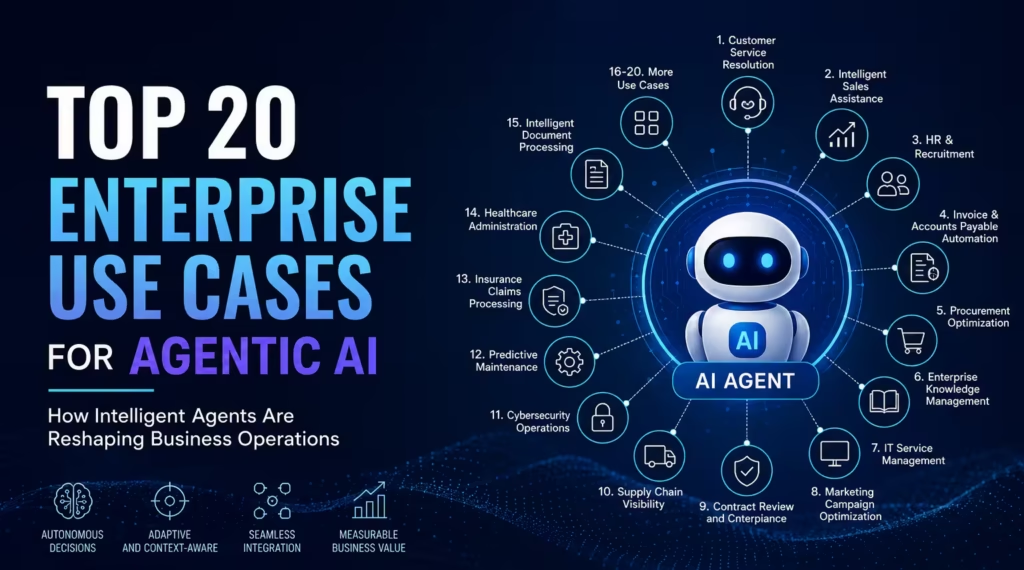
Top 20 Enterprise Use Cases for Agentic AI
While the first wave of AI focused on generating content, answering questions, and assisting employees, the next wave is about taking action. This evolution is known as Agentic AI—intelligent systems capable of planning, reasoning, making decisions, and executing complex business workflows with minimal human intervention. Unlike traditional automation, which follows predefined rules, Agentic AI adapts […]
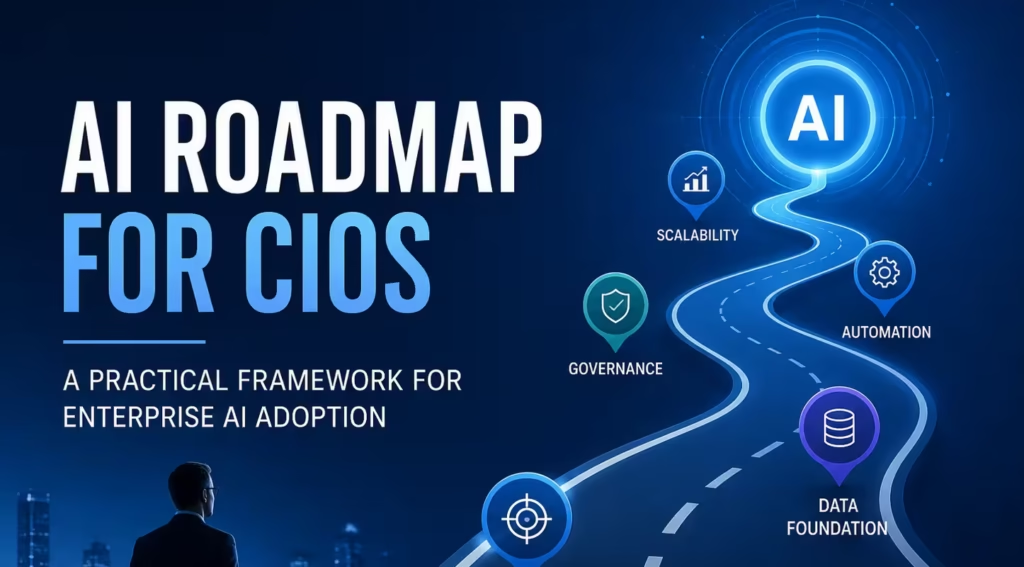
AI Roadmap for CIOs | Enterprise AI Strategy & Adoption Guide
Organizations across industries are investing in AI to improve productivity, automate processes, enhance customer experiences, and make data-driven decisions. However, while enthusiasm for AI is high, many initiatives fail to move beyond pilot projects because organizations lack a structured implementation strategy. For Chief Information Officers (CIOs), the challenge is no longer deciding whether to adopt […]
AI Workforce Management for Enterprise Leaders
For decades, workforce management has focused on people—hiring, training, scheduling, performance management, and employee engagement. As Artificial Intelligence becomes embedded into everyday business operations, a new challenge is emerging: organizations must now manage not only human employees but also intelligent AI agents, automation workflows, and digital assistants. This shift marks the beginning of AI Workforce […]