
While the first wave of AI focused on generating content, answering questions, and assisting employees, the next wave is about taking action. This evolution is known as Agentic AI—intelligent systems capable of planning, reasoning, making decisions, and executing complex business workflows with minimal human intervention.
Unlike traditional automation, which follows predefined rules, Agentic AI adapts to changing business conditions, interacts with multiple enterprise applications, collaborates with other AI agents, and learns from outcomes. Rather than replacing employees, these intelligent agents augment human capabilities by handling repetitive, data-intensive, and time-consuming tasks.
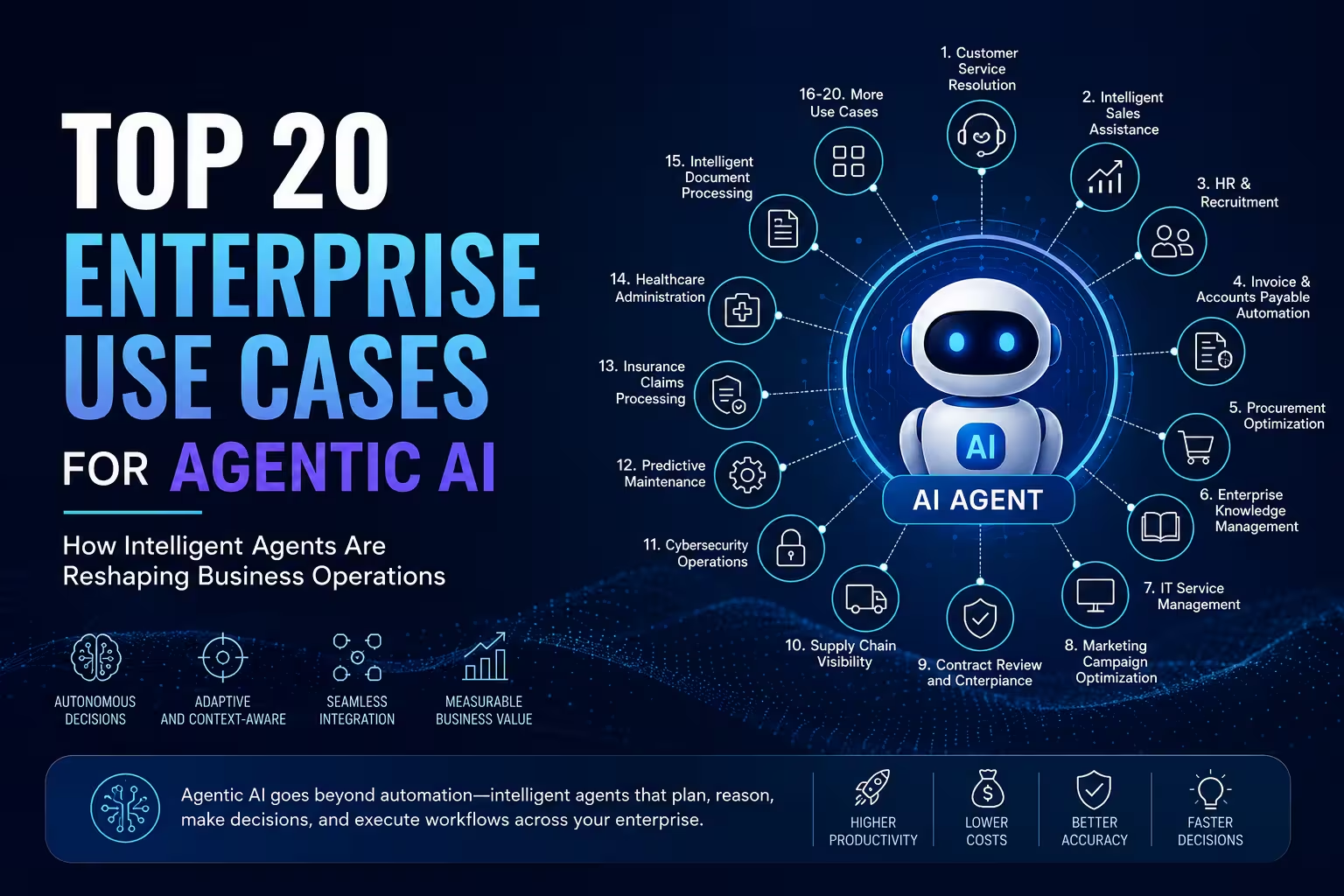
Organizations across industries are now exploring Agentic AI to improve productivity, enhance customer experiences, reduce operational costs, and accelerate digital transformation. Below are twenty enterprise use cases demonstrating how this technology is creating measurable business value.
1. Customer Service Resolution
Modern customer support extends beyond answering questions. An AI agent can authenticate customers, retrieve order details, review previous interactions, initiate refunds, escalate technical issues, and provide status updates—all within a single workflow. Human agents intervene only when empathy or complex judgment is required.
2. Intelligent Sales Assistance
Sales teams spend valuable time researching prospects, updating CRM records, and following up on leads. Agentic AI can monitor buying signals, qualify opportunities, generate personalized outreach, schedule meetings, and recommend the next best action based on customer behavior. This allows sales professionals to focus on relationship building instead of administrative work.
3. Human Resources and Recruitment
Recruitment involves coordinating multiple tasks across different systems. AI agents can screen resumes, compare candidate skills with job requirements, schedule interviews, collect feedback from interview panels, and prepare offer documentation. Recruiters remain responsible for final hiring decisions while the agents streamline the overall process.
4. Invoice and Accounts Payable Automation
Finance departments often process thousands of invoices each month. Agentic AI can extract invoice data, validate purchase orders, identify discrepancies, route approvals, and update ERP systems automatically. This reduces manual effort while improving financial accuracy and compliance.
5. Procurement Optimization
Procurement agents continuously monitor inventory levels, supplier performance, pricing trends, and contract terms. When stock reaches predefined thresholds, they can recommend preferred vendors, generate purchase requests, and initiate approval workflows without manual intervention.
6. Enterprise Knowledge Management
Employees frequently waste time searching for information scattered across SharePoint, Teams, document repositories, and internal portals. An enterprise AI agent can retrieve relevant information, summarize documents, answer policy-related questions, and recommend supporting resources, enabling employees to make faster and more informed decisions.
7. IT Service Management
IT support teams handle a high volume of repetitive service requests. Agentic AI can diagnose common technical issues, reset passwords, provision user accounts, assign software licenses, monitor system health, and resolve routine incidents before they impact business operations.
8. Marketing Campaign Optimization
Marketing teams manage multiple campaigns across different channels. AI agents can analyze campaign performance, recommend budget adjustments, personalize customer journeys, generate marketing content, and identify audience segments most likely to convert, enabling continuous optimization rather than periodic reviews.
9. Contract Review and Compliance
Legal departments spend considerable time reviewing contracts for risks and compliance issues. Agentic AI can compare agreements against company policies, identify unusual clauses, highlight missing information, and generate summaries that help legal professionals complete reviews more efficiently.
10. Supply Chain Visibility
Supply chains generate vast amounts of operational data. AI agents can monitor inventory, transportation schedules, supplier performance, and delivery timelines. When disruptions occur, they can recommend alternative suppliers, optimize logistics routes, and notify stakeholders before delays affect customers.
11. Cybersecurity Operations
Security teams receive thousands of alerts every day, many of which are false positives. Agentic AI can correlate security events, investigate suspicious activity, prioritize threats based on risk, and initiate predefined response actions while keeping security analysts informed throughout the process.
12. Predictive Maintenance
Manufacturing organizations rely on equipment operating at peak performance. AI agents continuously analyze sensor data, detect unusual operating conditions, predict equipment failures, and schedule maintenance activities before unexpected downtime occurs.
13. Insurance Claims Processing
Claims processing requires reviewing multiple documents, validating information, and detecting potential fraud. Agentic AI accelerates this process by gathering supporting evidence, evaluating claim details, estimating settlement values, and preparing recommendations for human adjusters.
14. Healthcare Administration
Healthcare professionals often spend excessive time on administrative work. AI agents can automate appointment scheduling, insurance verification, patient follow-ups, and document management, allowing clinical staff to dedicate more time to patient care while improving operational efficiency.
15. Intelligent Document Processing
Organizations process contracts, invoices, tax forms, purchase orders, and compliance documents every day. Agentic AI combines document understanding, data extraction, validation, and workflow automation to transform unstructured documents into actionable business information.
16. Executive Decision Support
Business leaders require timely insights rather than raw data. Agentic AI can consolidate information from finance, operations, HR, sales, and customer service systems to generate executive summaries, identify business risks, highlight performance trends, and recommend strategic actions based on organizational goals.
17. Data Quality Management
Reliable data is essential for analytics and AI initiatives. Agentic AI continuously monitors enterprise databases, detects duplicate records, validates information, recommends corrections, and improves data consistency across business applications without requiring constant manual oversight.
18. Regulatory Compliance
Organizations operating in regulated industries face evolving compliance requirements. AI agents can monitor regulatory updates, evaluate business processes against compliance standards, generate audit-ready reports, and notify stakeholders when corrective action is required.
19. Project Coordination
Project managers spend significant time tracking progress and coordinating resources. Agentic AI can monitor project milestones, identify delivery risks, assign tasks, generate status reports, and remind team members of upcoming deadlines. The result is improved visibility and fewer project delays.
20. End-to-End Business Process Orchestration
The most significant value of Agentic AI lies in orchestrating complete business processes rather than automating isolated tasks. Consider employee onboarding: one agent generates the offer letter, another provisions IT accounts, another schedules mandatory training, while another tracks completion and informs managers. Multiple specialized agents collaborate seamlessly to deliver a connected, efficient experience.
Looking Ahead
Agentic AI is redefining enterprise automation by moving beyond task execution to intelligent decision-making and process orchestration. As organizations integrate AI into core business operations, success will depend not only on deploying intelligent agents but also on establishing strong governance, security, and human oversight.
The organizations that gain the greatest value from Agentic AI will be those that treat it as a strategic capability rather than a standalone technology. By starting with high-impact business processes, measuring outcomes, and scaling thoughtfully, enterprises can unlock new levels of productivity, agility, and innovation.
For business leaders, the question is no longer whether Agentic AI will influence enterprise operations—it is how quickly they can adopt it responsibly and transform the way work gets done.
Top 20 Enterprise Use Cases for Agentic AI
While the first wave of AI focused on generating content, answering questions, and assisting employees, the next wave is about taking action. This evolution is known as Agentic AI—intelligent systems capable of planning, reasoning, making decisions, and executing complex business workflows with minimal human intervention. Unlike traditional automation, which follows predefined rules, Agentic AI adapts […]
AI Roadmap for CIOs | Enterprise AI Strategy & Adoption Guide
Organizations across industries are investing in AI to improve productivity, automate processes, enhance customer experiences, and make data-driven decisions. However, while enthusiasm for AI is high, many initiatives fail to move beyond pilot projects because organizations lack a structured implementation strategy. For Chief Information Officers (CIOs), the challenge is no longer deciding whether to adopt […]
AI Workforce Management for Enterprise Leaders
For decades, workforce management has focused on people—hiring, training, scheduling, performance management, and employee engagement. As Artificial Intelligence becomes embedded into everyday business operations, a new challenge is emerging: organizations must now manage not only human employees but also intelligent AI agents, automation workflows, and digital assistants. This shift marks the beginning of AI Workforce […]