
For decades, workforce management has focused on people—hiring, training, scheduling, performance management, and employee engagement. As Artificial Intelligence becomes embedded into everyday business operations, a new challenge is emerging: organizations must now manage not only human employees but also intelligent AI agents, automation workflows, and digital assistants.
This shift marks the beginning of AI Workforce Management, where humans and AI collaborate as part of the same operating model. Rather than replacing employees, AI is becoming a digital workforce that handles repetitive tasks, supports decision-making, and executes business processes around the clock.
For CIOs and business leaders, the question is no longer “How do we deploy AI?” but “How do we effectively manage a workforce that includes both people and intelligent digital workers?”
What Is AI Workforce Management?
AI Workforce Management is the practice of planning, governing, monitoring, and optimizing work performed by both human employees and AI-powered systems.
Traditional workforce management answers questions such as:
- How many employees are needed?
- What skills are required?
- How is productivity measured?
AI Workforce Management expands these questions to include:
- Which tasks should be performed by AI?
- Which decisions require human oversight?
- How should AI agents collaborate with employees?
- How is AI performance measured?
- Who is accountable for AI-driven decisions?
The objective is not to automate everything but to create the most effective partnership between people and technology.
Why the Workforce Is Changing
Modern enterprises operate in an environment where speed, accuracy, and scalability are critical. Employees are expected to process increasing volumes of information while responding quickly to customers and business demands.
AI enables organizations to shift routine, repetitive, and data-intensive work to digital workers, allowing employees to focus on creativity, collaboration, innovation, and strategic decision-making.
Examples include:
- Customer service agents assisted by AI copilots.
- Finance teams using AI to process invoices and reconcile accounts.
- HR professionals relying on AI to screen candidates and schedule interviews.
- IT teams using autonomous agents to resolve routine service requests.
- Sales teams receiving AI-generated insights and opportunity recommendations.
The result is a workforce where humans and AI complement one another rather than compete.
The Five Pillars of AI Workforce Management
Successful organizations treat AI as a managed workforce, not simply another software application.
1. Workforce Planning
Every process should begin with a clear understanding of which activities are best suited for humans and which can be delegated to AI.
Tasks that involve repetitive analysis, document processing, or standardized decision-making are often ideal for AI. Activities requiring empathy, negotiation, ethics, or complex judgment remain the responsibility of people.
2. Governance and Accountability
Every AI agent should have defined responsibilities, operating boundaries, and human oversight.
Organizations should establish policies covering:
- Decision approval thresholds
- Access permissions
- Audit trails
- Data privacy
- Regulatory compliance
- Risk management
Clear accountability builds trust and reduces operational risk.
3. Performance Management
Just as employees have KPIs, digital workers should also be measured.
Useful metrics include:
- Task completion rate
- Processing accuracy
- Response time
- Error rate
- Cost savings
- Business impact
- Human intervention frequency
Monitoring these metrics helps organizations continuously improve AI performance.
4. Collaboration
The greatest value comes from collaboration rather than replacement.
For example, an AI agent may analyze customer data, prepare recommendations, and draft responses, while an employee validates the outcome and manages the customer relationship.
This shared approach combines AI speed with human judgment.
5. Continuous Improvement
AI models, business processes, and organizational priorities evolve over time.
Organizations should regularly review:
- Workflow effectiveness
- AI accuracy
- Employee feedback
- Regulatory changes
- Technology updates
Continuous optimization ensures that both human and digital workers remain aligned with business goals.
Challenges Organizations Must Address
Adopting AI Workforce Management is not without challenges.
Business leaders must address concerns around data quality, cybersecurity, governance, employee adoption, and ethical AI use. Equally important is change management. Employees need to understand how AI supports their work rather than viewing it as a threat.
Transparent communication, ongoing training, and clearly defined roles are essential for building confidence in AI-enabled workplaces.
Building an AI-Ready Workforce
Organizations that succeed with AI invest as much in people as they do in technology.
An AI-ready workforce includes:
- Employees who understand AI capabilities and limitations.
- Managers who redesign workflows around human-AI collaboration.
- IT teams that govern and monitor AI systems.
- Leaders who measure AI success through business outcomes rather than technology adoption alone.
This balanced approach enables organizations to innovate while maintaining trust and accountability.
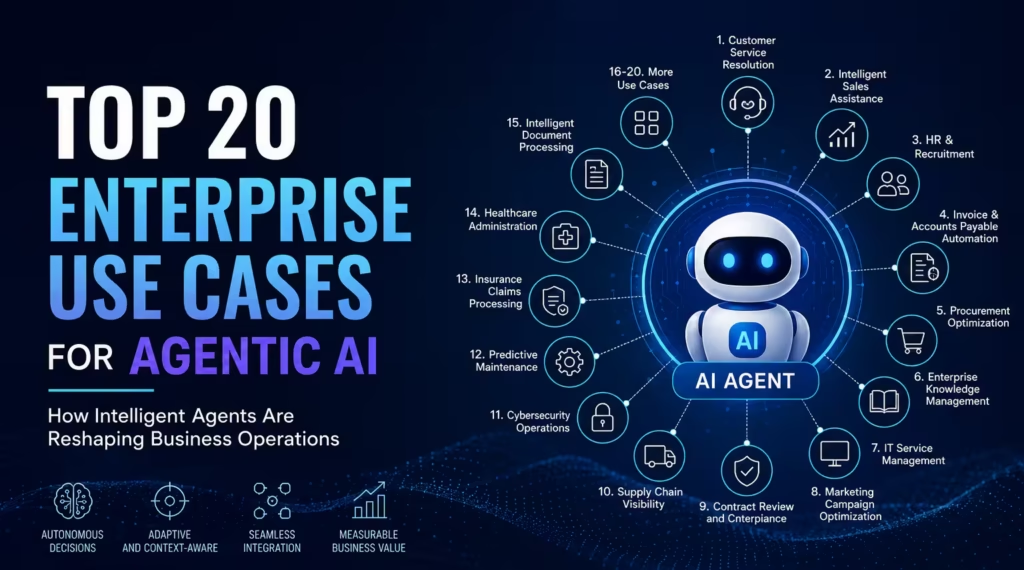
Top 20 Enterprise Use Cases for Agentic AI
While the first wave of AI focused on generating content, answering questions, and assisting employees, the next wave is about taking action. This evolution is known as Agentic AI—intelligent systems capable of planning, reasoning, making decisions, and executing complex business workflows with minimal human intervention. Unlike traditional automation, which follows predefined rules, Agentic AI adapts […]
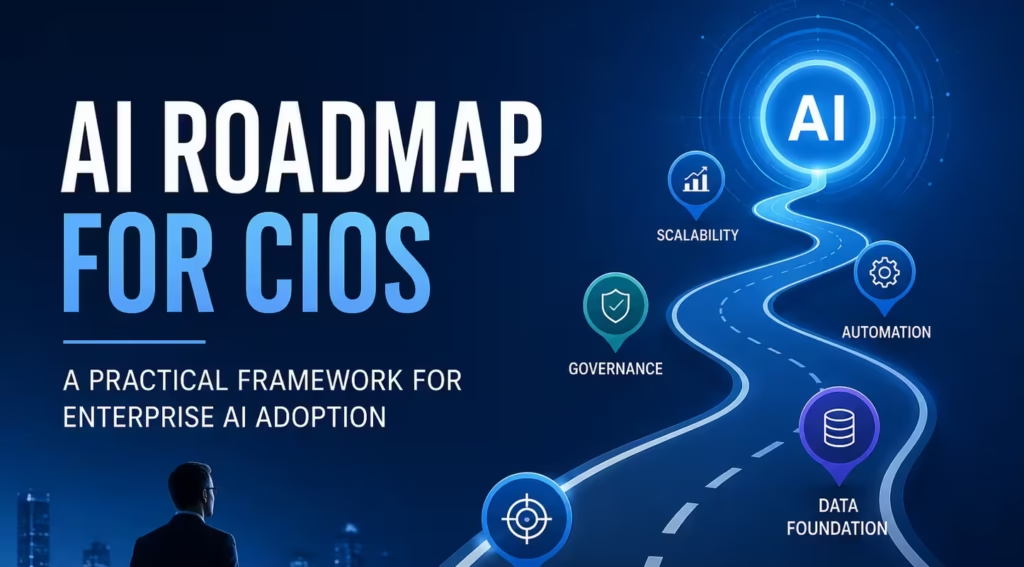
AI Roadmap for CIOs | Enterprise AI Strategy & Adoption Guide
Organizations across industries are investing in AI to improve productivity, automate processes, enhance customer experiences, and make data-driven decisions. However, while enthusiasm for AI is high, many initiatives fail to move beyond pilot projects because organizations lack a structured implementation strategy. For Chief Information Officers (CIOs), the challenge is no longer deciding whether to adopt […]
AI Workforce Management for Enterprise Leaders
For decades, workforce management has focused on people—hiring, training, scheduling, performance management, and employee engagement. As Artificial Intelligence becomes embedded into everyday business operations, a new challenge is emerging: organizations must now manage not only human employees but also intelligent AI agents, automation workflows, and digital assistants. This shift marks the beginning of AI Workforce […]