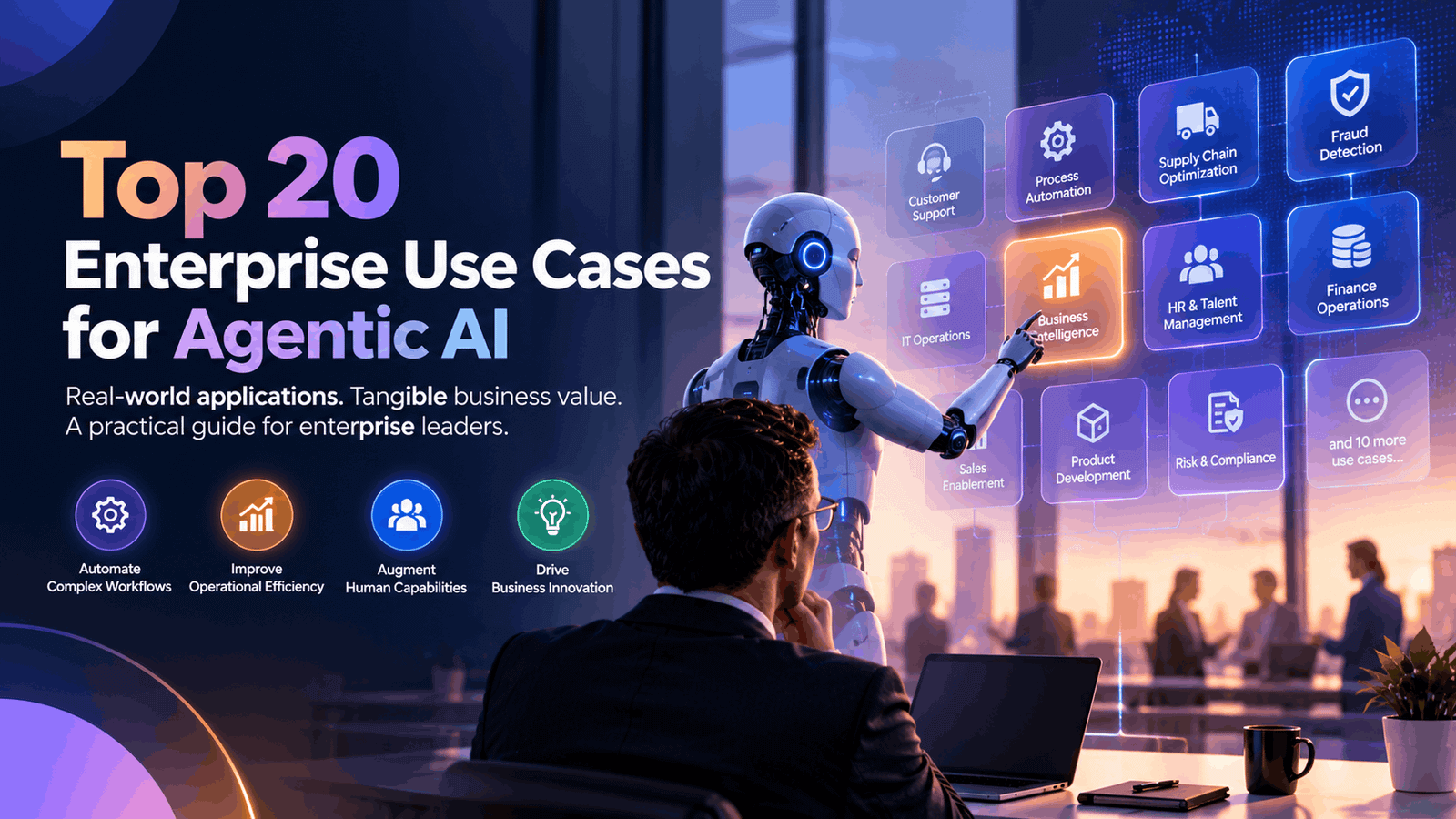
Enterprise AI is evolving beyond chatbots and content generation. In 2026, businesses are exploring agentic AI to manage complex workflows, coordinate business applications, analyze information, and complete multi-step tasks with limited human intervention.
Unlike conventional automation, which typically follows predefined rules, AI agents can interpret objectives, plan actions, use connected tools, and adapt to intermediate results within defined permissions.
For enterprises managing large teams, complex processes, and multiple software systems, this creates opportunities to improve productivity, streamline operations, and support better decision-making.
According to McKinsey’s 2026 State of AI research, the share of surveyed organizations scaling AI agents in at least one business function increased from 27% to 40% among larger organizations. However, adoption remains uneven, making practical use-case selection and responsible implementation essential.
Here are 20 enterprise use cases for agentic AI that organizations can explore.
What Is Agentic AI in Enterprise Business?
Agentic AI refers to AI systems designed to pursue defined goals by planning and carrying out sequences of actions. Depending on their configuration, agents can retrieve information, call APIs, update records, communicate with other systems, and request human approval when necessary.
For example, a customer service agent might identify a delivery problem, check order information, review shipping status, prepare a resolution, and escalate unusual cases to an employee.
The business value comes from coordinating multiple steps rather than automating a single isolated activity.
Top 20 Enterprise Use Cases for Agentic AI
1. Customer Service Automation
AI agents can handle routine customer requests, retrieve order information, explain policies, and coordinate service resolutions across connected platforms. Complex complaints can be escalated to human representatives.
Business impact: Faster responses and reduced repetitive support work.
2. Sales Lead Qualification
Sales agents can review incoming leads, summarize customer requirements, enrich CRM records using approved sources, and prioritize follow-ups based on predefined criteria.
Business impact: Better lead organization and more focused sales activity.
3. Marketing Campaign Management
Marketing agents can analyze campaign performance, identify audience segments, suggest content variations, and prepare campaign adjustments for approval.
Business impact: More efficient campaign coordination and data-informed marketing decisions.
4. IT Help Desk Operations
Enterprise IT agents can troubleshoot common technical issues, guide employees through approved fixes, classify tickets, and escalate incidents requiring specialist intervention.
Business impact: Faster ticket handling and improved service desk efficiency.
5. Software Development and Testing
Development agents can examine code repositories, suggest changes, generate tests, investigate bugs, and summarize code reviews. Human developers should review important changes before deployment.
Business impact: Less repetitive engineering work and potentially faster development cycles.
6. Cybersecurity Monitoring
Security agents can investigate alerts, correlate events across monitoring tools, summarize suspicious activity, and recommend containment measures. High-impact actions should follow strict authorization policies.
Business impact: Faster investigation and improved incident response.
7. Financial Reporting and Analysis
Finance agents can collect approved financial data, reconcile information, explain variances, and prepare management reports for review.
Business impact: Reduced reporting effort and improved access to financial insights.
8. Invoice and Accounts Payable Processing
Agents can extract invoice details, match records against purchase orders, flag discrepancies, and route invoices through approval workflows.
Business impact: More consistent processing and fewer manual data-entry tasks.
9. Supply Chain Optimization
Supply chain agents can monitor inventory, assess supplier updates, identify potential delays, and recommend alternative sourcing or replenishment plans.
Business impact: Improved supply chain visibility and faster operational responses.
10. Predictive Maintenance
Manufacturing agents can analyze equipment sensor data and maintenance records to identify warning signs, recommend inspections, and schedule approved maintenance activities.
Business impact: Better maintenance planning and reduced risk of unexpected downtime.
11. Human Resources Support
HR agents can answer policy questions, guide employees through internal processes, and help organize onboarding tasks and documentation.
Business impact: Less administrative work for HR teams and more accessible employee support.
Hiring and performance decisions should remain subject to appropriate human oversight.
12. Employee Onboarding
Onboarding agents can coordinate account requests, training assignments, document collection, and introductory communications across HR and IT systems.
Business impact: A more consistent onboarding experience and fewer missed steps.
13. Enterprise Knowledge Management
Knowledge agents can search authorized internal documents, summarize policies, retrieve project information, and provide source references to help employees verify answers.
Business impact: Faster information discovery and better knowledge sharing.
14. Contract Analysis and Legal Operations
Legal agents can summarize contracts, identify unusual clauses, compare document versions, and flag terms requiring legal review.
Business impact: More efficient document review without removing the need for qualified legal judgment.
15. Procurement Management
Procurement agents can compare supplier proposals, check purchase requests against company policies, track delivery updates, and prepare recommendations for buyers.
Business impact: Better purchasing visibility and more streamlined procurement workflows.
16. Customer Personalization
Customer experience agents can use permitted customer preferences and interaction history to recommend relevant products, tailor communications, and coordinate service follow-ups.
Business impact: More relevant customer interactions and potentially improved engagement.
17. Regulatory Compliance Monitoring
Compliance agents can review approved records, monitor policy changes, flag potential exceptions, and prepare evidence for internal audits.
Business impact: Earlier identification of issues and more organized compliance processes.
18. Business Intelligence and Decision Support
Analytics agents can retrieve information from authorized data sources, investigate changes in key performance indicators, and generate explanations or follow-up questions for business leaders.
Business impact: Faster analysis and more accessible business insights.
19. Logistics and Fleet Management
Logistics agents can monitor shipments, identify route disruptions, compare delivery options, and coordinate status updates across transport systems.
Business impact: Better exception management and improved delivery coordination.
20. Research and Product Innovation
Research agents can review scientific literature, summarize market trends, compare product requirements, and organize feedback for product development teams.
Business impact: More efficient research and better-informed innovation decisions.
How to Implement Agentic AI Successfully
Selecting the right use case is only the beginning. Enterprises need a structured implementation strategy to turn experimentation into measurable results.
- Identify a clear business problem. Start with a workflow involving repetitive coordination, information gathering, or predictable decisions.
- Evaluate data readiness. Confirm that agents can access accurate, relevant information through secure and approved connections.
- Set permissions and boundaries. Define which actions agents can perform independently and which require human approval.
- Run a controlled pilot. Test realistic scenarios, including incorrect inputs, unusual requests, and system failures.
- Measure business outcomes. Track processing time, cost per task, error rates, service quality, and employee feedback.
- Expand gradually. Scale only after the workflow demonstrates reliable performance and appropriate governance.
Security, accountability, and monitoring should be designed into the solution rather than added after deployment.
Challenges of Enterprise Agentic AI
Agentic AI introduces risks that enterprises must address before granting systems access to business-critical applications.
- Data privacy: Protect confidential information through access controls and approved data-handling policies.
- Incorrect actions: Use validation, testing, audit logs, and approval checkpoints.
- Integration complexity: Ensure that connected systems provide reliable data and clear error-handling mechanisms.
- Uncontrolled permissions: Limit agents to the minimum access required for their tasks.
- Unclear return on investment: Measure actual improvements rather than assuming that greater autonomy automatically creates value.
Deloitte’s 2026 State of AI in the Enterprise report highlights a significant governance gap: only one in five surveyed companies had a mature governance model for autonomous AI agents. Strong oversight is therefore an important part of enterprise adoption.
Conclusion
The top enterprise use cases for agentic AI extend across customer service, software engineering, finance, cybersecurity, supply chains, HR, and business intelligence. By coordinating multi-step workflows, AI agents can help organizations reduce repetitive effort and respond more effectively to operational demands.
However, successful adoption requires more than selecting a capable model. Enterprises must define business objectives, prepare reliable data, establish permissions, and measure outcomes carefully.
The most effective starting point is a focused workflow with clear success criteria and manageable risks. As reliability improves, organizations can expand toward more connected and sophisticated agentic AI solutions.
Looking to implement agentic AI in your business? Profilent can help your organization explore AI automation opportunities, streamline workflows, and develop a practical roadmap for enterprise AI adoption.
Frequently Asked Questions
What are the best enterprise use cases for agentic AI?
Common starting points include IT support, customer service, software development, knowledge management, invoice processing, and sales operations. The best choice depends on business value, data readiness, and risk.
How is agentic AI different from traditional automation?
Traditional automation generally follows predefined rules, while agentic AI can interpret goals, plan multiple steps, use connected tools, and adapt to intermediate results within defined limits.
Is agentic AI suitable for large enterprises?
Yes. Large organizations can use AI agents to coordinate workflows across departments and software systems, provided they have appropriate security, integration, monitoring, and governance controls.
How can enterprises measure agentic AI ROI?
Measure changes in processing time, operating costs, error rates, service quality, employee productivity, and customer outcomes against a baseline established before implementation.
What is the biggest risk of agentic AI adoption?
A major risk is granting an agent more access or autonomy than its task requires. Permission limits, testing, audit trails, and human approval for consequential actions help reduce this risk.